- Published on
CH4 Appendix. Antenna & Propagation
- Authors

- Name
- seren-wib
Contents
9. Antenna & Propagation
9-1 Antenna basics
- Definition: a device that converts between electrical signals and electromagnetic waves
[Transmitting antenna]
   Current of a specific frequency is input
        ↓
   Magnetic field generated (current → magnetic field)
        ↓
   Changing magnetic field → induces electric field
        ↓
   Changing electric field → induces magnetic field
        ↓
   (repeats this process while propagating through space)
        ↓
[Receiving antenna]
   Detects the change of the magnetic field over time
        ↓
   Induces current → converted into an electrical signal
The electric and magnetic fields induce each other and spread through space. This is the essence of an electromagnetic wave
9-2 Characteristics of electromagnetic waves
1. Attenuation with distance
- In free space, received power is inversely proportional to the square of the distance
Pt
Pr ∝ ─────
        R²

Pt: transmitted power
Pr: received power
R: distance
2. Five characteristics of radio waves
Linearity (rectilinear propagation) Travels the shortest path, the way light travels in a straight line Stronger at higher frequencies
Reflection Changes path when it hits a material Metal surfaces, walls, etc.
Refraction Direction and speed change when entering a different medium Atmospheric layers, glass, etc.
Diffraction Bends around the edges of obstacles Signals can reach even behind obstacles
Scattering Scattered in all directions by obstacles Rain, fog, dust, etc.
- Why communication is possible even over a mountain: even though high frequencies have strong linearity, the signal bends in behind obstacles thanks to the diffraction characteristic.
3. Fading
- Because of reflection, scattering and diffraction of radio waves, one signal arrives over multiple paths. Each path has a different length, so arrival times differ → interference occurs.
- This is called multipath interference
9-3 Antenna performance parameters
- There are 3 main parameters
- Radiation Pattern
- Directivity & gain
- Polarization
1. Radiation Pattern
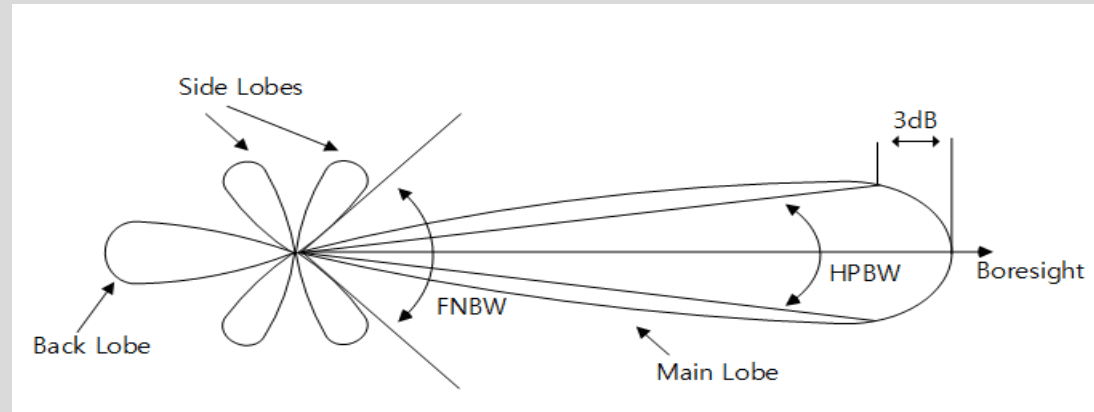
- A graph showing in which direction and how much signal an antenna radiates
- No antenna radiates uniformly in all directions. Some directions are strong, some are weak. The radiation pattern visualizes this
| Term | Meaning |
|---|---|
| Main lobe | The main beam where maximum power is radiated |
| Side lobe | Secondary beams formed between the main and back lobes |
| Back lobe | The beam formed in the direction directly opposite the main lobe |
| Boresight | The reference direction the antenna points to (main lobe center) |
| HPBW (Half Power Beam Width) | Beam width out to the points where power is half the max (-3dB) |
| FNBW (First Null Beam Width) | Beam width out to the points where power first drops to 0 |
2. Directivity and gain
- Directivity
- The property of an antenna to concentrate radio waves in a particular direction
Physical definition
        max radiation intensity (U_max)
D = ─────────────────────────────
        avg radiation intensity (U_avg)

Ratio of maximum radiation intensity to average radiation intensity
High directivity = concentrates the signal in one direction = the main lobe is narrow and long.
- Omnidirectional antenna: dipole antenna, spreads out in all directions
- Directional antenna: parabolic antenna, concentrates in one direction
- Antenna efficiency and gain
Antenna efficiency (η) = radiated power (Pr) / input power (Pi)
   "How much of the input power is actually radiated"

Antenna gain (G) = η × D
              = efficiency × directivity

Gain is expressed in dB
Meaning of gain: when radiating the same power in the same direction, how many times stronger it is than an omnidirectional antenna.
- Trade-off between gain and beam width
- High gain = narrow beam width = high directivity
- Gain and beam width are always inversely proportional
3. Polarization
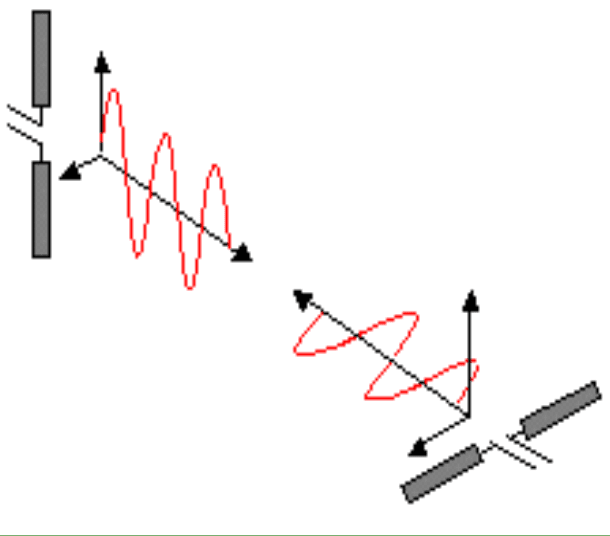
- The direction in which the electric field (E) oscillates as an electromagnetic wave travels
- If the polarization directions of the transmitting and receiving antennas differ, transmission/reception performance degrades.
- If they are completely orthogonal, no signal can be exchanged
- Types: vertical polarization, horizontal polarization