
- Published on
CH8. Multiplexing
- Authors

- Name
- seren-wib
Contents
- Multiplexing: a technique that lets multiple signals share one link
- Split into FDM and TDM by how the line (link) is divided
- 1. FDM(Frequency Division Multiplexing) — divided by frequency
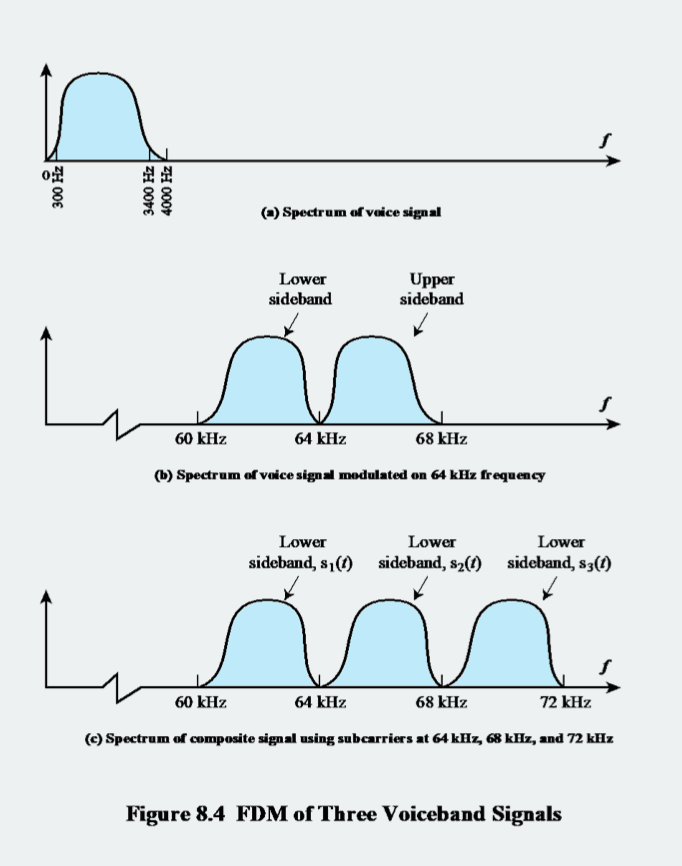
- FDM example
- 2. TDM (Time Division Multiplexing) — divided by time
- 3. WDM(Wavelength Division Multiplexing) — the optical fiber version of FDM
- 4. Duplex application
- 5. Multiple Channel Access application
- Multiplexing: a technique that lets multiple signals share one link
- Split into FDM and TDM by how the line (link) is divided
- 1. FDM(Frequency Division Multiplexing) — divided by frequency
- 2. TDM (Time Division Multiplexing) — divided by time
- 3. WDM(Wavelength Division Multiplexing) — the optical fiber version of FDM
- 4. Duplex application
- 5. Multiple Channel Access application
Multiplexing: a technique that lets multiple signals share one link
Links are expensive, so having multiple signals share one line improves cost efficiency
input1 ─┐                                    ┌─ output1
input2 ─┤                                    ├─ output2
  ⋮     ├─[ MUX ]══ 1 link, n channels ══[ DEMUX ]┤   ⋮
inputn ─┘                                    └─ outputn
MUX (Multiplexer): bundles multiple inputs into one and puts them on the line
DEMUX (Demultiplexer): splits them back into n at the destination
Split into FDM and TDM by how the line (link) is divided
1. FDM(Frequency Division Multiplexing) — divided by frequency
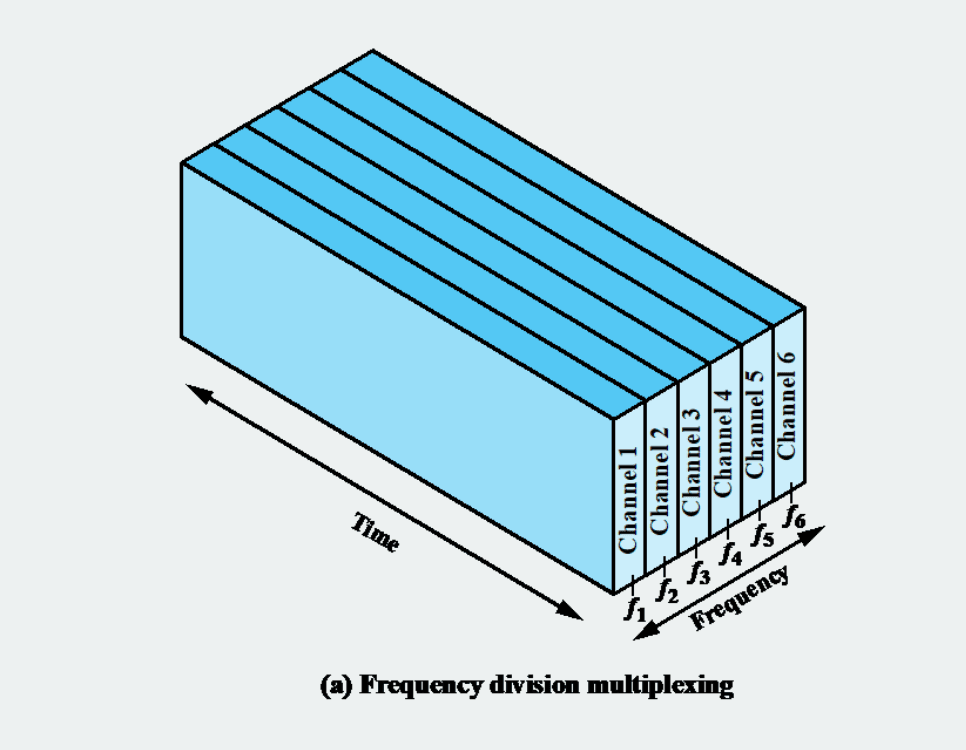
- Divides the line's frequency band into several pieces and assigns a different frequency to each channel
- All channels flow at the same time (each has its own frequency, so they don't mix)
- A guard band (an empty frequency buffer zone) is placed between channels to prevent interference
Same as radio, where many stations broadcast at the same time but don't mix because their frequencies differ (89.1, 91.9...)
FDM example
2. TDM (Time Division Multiplexing) — divided by time
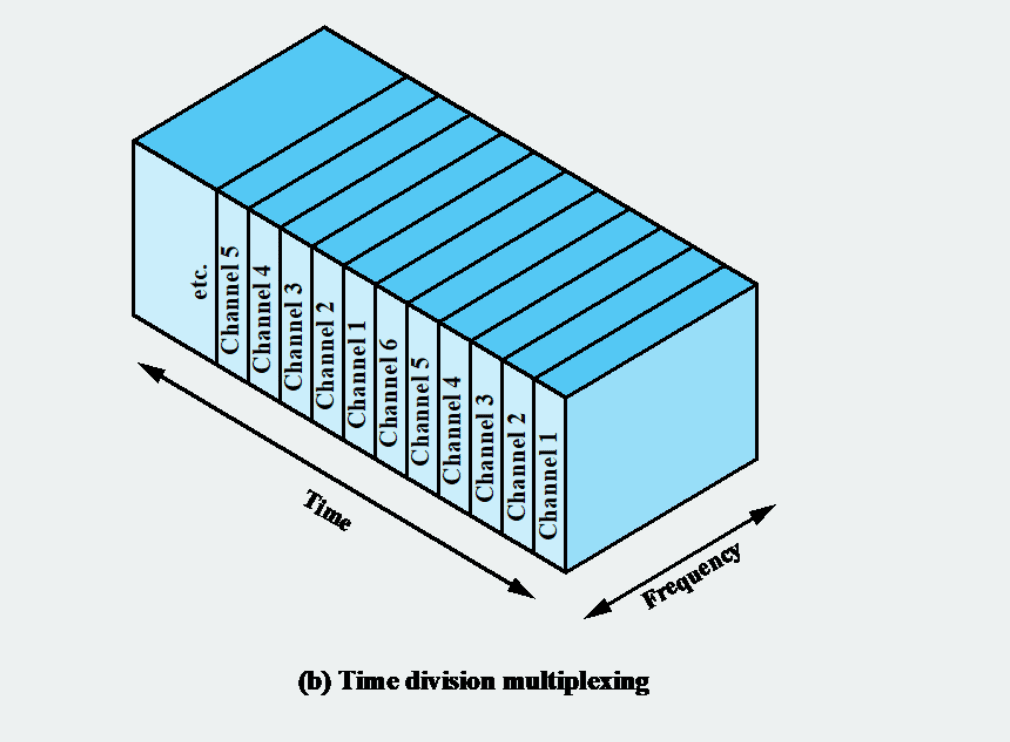
- Time is chopped into small pieces (time slots) and the channels take turns monopolizing the line
- Only one channel uses it at any instant, but it cycles so fast that they look like they're using it simultaneously
- Analogy: scheduling one meeting room — team A at 9:00, team B at 9:10... and rotating it
3. WDM(Wavelength Division Multiplexing) — the optical fiber version of FDM
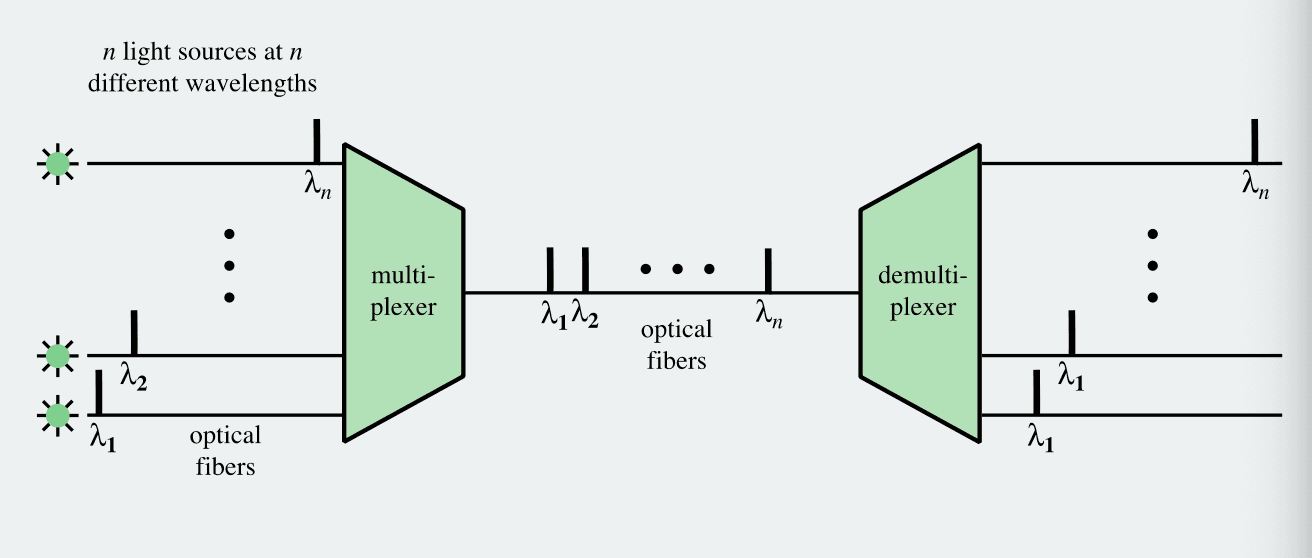
- Puts several different wavelengths (colors of light) on a single strand of optical fiber
- The principle is exactly the same as FDM. (frequency = wavelength for light). The medium is just optical fiber and the signal is light
- Commercial systems: 160 channels × 10 Gbps class. 1550 nm lasers → MUX combines them → an optical amplifier amplifies all wavelengths at once → DEMUX separates them
4. Duplex application
Separating two-way communication
How to divide sending and receiving (both directions)
- FDD (Frequency-Division Duplex): separates the sending direction and the receiving direction by different frequencies
- TDD (Time-Division Duplex): separates them by time (time is split between sending and receiving)
- Tp propagation delay, Tb burst transmission time, Tg guard time
5. Multiple Channel Access application
How to divide access when several terminals attach to one base station
- FDMA: assigns a different frequency band to each terminal (multiple access in the FDM style)
- TDMA: assigns a different time slot to each terminal (multiple access in the TDM style)