
- Published on
CH3. Project Planning and Cost Estimation
- Authors

- Name
- seren-wib
Contents
- 3. Project Planning and Cost Estimation
- 3.1 What Is a Project?
- 3.2 Project Identification
- 3.3 Project Management and the Project Manager
- 3.4 Work Planning and Scheduling
- 3.5 Software Development Cost Factors
- 3.6 Types of Project Cost Estimation Models and the Procedure
- Cost estimation models
- 5 steps to prepare a cost estimate
- 3.7 LOC-Based Project Cost Estimation
- 3.8 Function Point-Based Project Cost Estimation
- 3.9 Organization Planning
- 3.10 Risk Management Planning
- 3.11 Business Feasibility Analysis
- 3.12 Project Management Standards
3. Project Planning and Cost Estimation
3.1 What Is a Project?
Task: a fragmentary piece of work with few time or budget constraints
Project: planned work that must achieve a specific goal within limited time and cost
- It is completed by a project team led by a project manager (PM) and needs resources.
Work: a single unit of work performed inside a project
| 4 elements of a production system (4M) | Production resources (4M) |
|---|---|
| Man | Man |
| Machine | Machine |
| Material | Material |
| Method | Money |
- The first three are the same and only the last one differs: a production system has Method, production resources have Money
Essentials for a successful SW project: people, resources (lab equipment, materials), capital, technology, time
What goes into a SW project plan: work plan, work method (technology) plan, resource plan, organization plan, schedule, budget plan, risk management plan, maintenance plan
3.2 Project Identification
System Request: a document explaining why the system should be built and what value it creates
- Components: project sponsor, business need, business requirements, business value, special issues
Project sponsor: a stakeholder
Business requirements: why the system is built + an outline of the functions it gives the organization
Work plan: provides the WBS (work breakdown structure)
Feasibility analysis
- Components: economic feasibility, technical feasibility, organizational feasibility, legal and environmental feasibility, schedule feasibility
3.3 Project Management and the Project Manager
Project management life cycle: initiation → planning → execution → maintenance
Project management: managing a project to reach its goals under the given constraints
- Components: work planning, risk assessment, resource estimation, organization, resource acquisition, work direction, progress tracking, result analysis
Main roles of the project manager (PM)
- Planning, winning the contract, preparation
- Contract support, planning, writing the proposal, writing the WBS, assigning work, securing resources, cost estimation, scheduling, risk management
- Management
- Managing overall progress: design, construction, testing, approval, etc.
- Budget management, progress management, keeping the work on course, performance reporting
- Maintenance
- Result analysis, acceptance support, maintenance support, sales support for finding new projects
3.4 Work Planning and Scheduling
Typical management tools: WBS, CPM network, Gantt chart, PERT chart
WBS: the project plan broken down into levels
CPM network: represented by a PERT chart.
- It visualizes well but can miss some factors.
PERT chart: a graphical representation of the timeline of individual tasks
- Components
- Node: event or milestone (circle or rectangle)
- Vector: lines showing tasks and the dependencies (precedence) between them
- How to draw it
- List the subtasks
- Draw the CPM network diagram
- Find every possible path in the CPM network and find the critical path (the longest path)
Gantt chart: a bar chart showing the project schedule
Schedule: a list of the activities, deliverables and milestones in a project
- Components: start and end dates, resources and similar information
- Process: plan schedule management → define activities → sequence activities → estimate resources → estimate durations → develop the schedule
- Types
- Master: a simple task list with a timeline
- Milestone: summary tasks
- Detailed: tracks every activity, used in large projects
- 7 principles: gather stakeholder input, refer to past projects, account for risks, account for non-working time, define the critical path, record assumptions, include milestones
3.5 Software Development Cost Factors
Research and planning, technology used, project size, UI/UX requirements, staff employment model, scale of maintenance and support
3.6 Types of Project Cost Estimation Models and the Procedure
Cost estimation models
- Heuristic techniques
- COCOMO (Constructive Cost Model): the representative heuristic technique, a LOC-based cost estimation regression model
- LOC (Line of Code) = counting how many lines the program has
- COCOMO (Constructive Cost Model): the representative heuristic technique, a LOC-based cost estimation regression model
- Analytical estimation techniques
- Function Point Analysis (FPA): computes cost from the number and complexity of functions
- Putnam model: a parametric model that estimates effort, time and defects
- Price-To-Win estimation model: based on market conditions and competitors' prices
- Machine learning based models
- IFPUG (International Function Point Users Group): the function point measurement standard provided by the International Function Point Users Group
5 steps to prepare a cost estimate
Big picture (module map) → what to build it with (technology) → what to build (SRS) → how it looks (UI) → split the work and price it (WBS)
- Write the project overview and a high-level module map
- Use cases, classes, methods, DB, UI, infrastructure and so on all go in here
- Research and choose the required technology
- Draft the SRS (software requirements specification)
- Requirement set, constraints, target users and so on
- Detailed UI design
- Write the WBS
3.7 LOC-Based Project Cost Estimation
- Basic COCOMO: reflects only a few constants (effort and schedule are the key variables)
- Has estimation methods for organic, semi-detached and embedded systems
- Intermediate COCOMO: additionally reflects 15 software engineering cost attributes
- Detailed COCOMO: splits the whole software into several modules and estimates and applies effort multipliers
3.8 Function Point-Based Project Cost Estimation
Function Point (FP): a unit that measures the amount of functionality a system provides to users
- How many functions there are and how complex they are
- Industry standard
5 components
| Category | Type | Meaning |
|---|---|---|
| Data functions | ILF (Internal Logical File) | Classes and tables defined inside our system |
| EIF (External Interface File) | Only references something defined in an external system | |
| Transaction functions | EI (External Input) | Operations that bring data in: insert, delete, update |
| EO (External Output) | Operations that send data to a screen, printer or file (reports) | |
| EQ (External Inquiry) | A search operation with both input and output (SQL search query) |
- ILF vs EIF: told apart by who defined it
- One search = EQ (inquiry) + EO (output)
Supporting terms
| Term | Meaning | Example |
|---|---|---|
| RET (Record Element Type) | Number of subclasses of an ILF or EIF | Employee → full-time, part-time = 2 |
| FTR (File Type Referenced) | Number of files referenced by an EI, EO or EQ | Student + department lookup = 2 |
| DET (Data Element Type) | Number of attributes | Student (ID, name, address, phone, resident number, department) = 6 |
5 steps of function point estimation
- Identify the function point types
- Rate the complexity (simple / average / complex)
- Compute the unadjusted function points (UFP)
- Apply the total degree of influence of system characteristics (TDI)
- Compute the final function points
3.9 Organization Planning
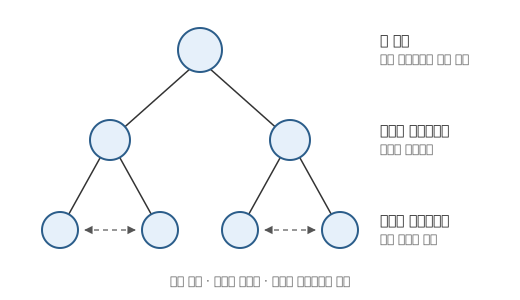
Ways to structure a team: hierarchical, chief programmer, matrix, democratic
Hierarchical team: tree structure, a sub-team leader for each functional sub-team
- Lower levels have detailed knowledge, upper levels understand the whole broadly
- Suited to large projects
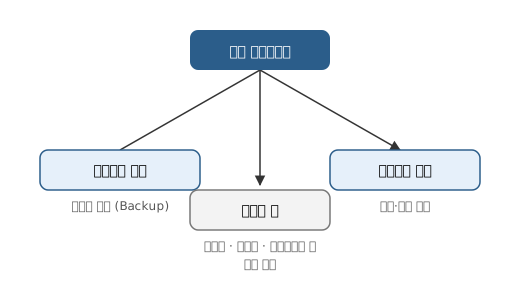
Chief programmer team: centered on the chief programmer
- Chief: planning, specification, design (up to implementation)
- Backup: technical peer
- Secretary: supports administrative work
- Specialists: do the implementation
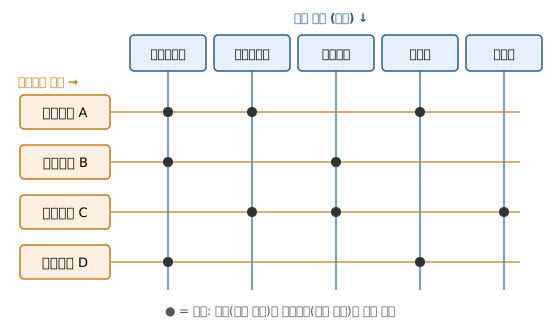
Matrix team: people belong to both a department (technology) and a project
- Project teams disband when the project ends, so skills don't accumulate → this solves that
- US aerospace industry in the 1950s; in Korea, LG
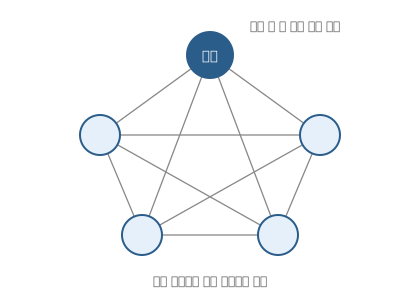
Democratic team: everyone discusses one-on-one
- The leader decides only when there is no consensus
Typical SW development team: PM, business analyst, SW architect, developers, QA, etc.
- The development team (offshore) communicates with the client (on-site)
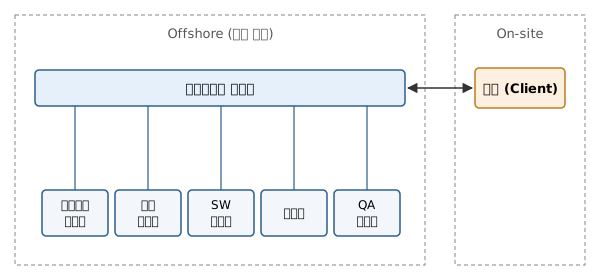
Agile development team: typical team + PM, UX/UI designer, QA engineer
3.10 Risk Management Planning
Risk management plan: a plan to find risks in advance, meet deadlines, communicate, and allocate money to eliminating risks
Technical risk: risk caused by technical problems or faulty tools
- Factors: poor code quality, constantly changing requirements, wrong technology choices, integration problems
- Mitigation: get all existing documents and discuss problems with the previous team. New technology makes the risk bigger
Operational risk: risk that arises in the process when development goals are unclear
- Factors: unreasonable or inaccurate deadlines, wrong time estimates, lower productivity (delays, staff burnout), poor management, scope changes (scope creep), no communication with stakeholders, communication mistakes
- Rushing by skipping important stages, lack of skilled developers, and unstable workloads are also risks
Business risk: risk that arises from the company's business interests and operations
- Factors: unmet stakeholder expectations, undefined metrics, inconsistent priorities, budget problems, low engagement, no partnership agreement, unpredictable external risks
- No partnership agreement → solved with a written contract
- External risks: changes in law, government regulations, economic changes, natural disasters, etc. → minimized with insurance and staying up to date
3.11 Business Feasibility Analysis
Feasibility analysis: reviewing and evaluating every aspect of a project
- Types: economic, technical, organizational, legal and environmental, schedule
Economic feasibility: whether it makes money
- Criteria: present value (PV), net present value (NPV), return on investment (ROI), break-even point (BEP)
- PV: future money converted to its value today
- NPV: present value of money coming in - present value of money going out
- ROI: return relative to investment
- BEP: revenue = total cost, the point with neither loss nor profit
Technical feasibility: whether it can be built technically
- The organization's technical skill, availability of existing technology, ability to meet HW and SW requirements, ability to secure resources and technology, maintainability
Organizational feasibility: whether the organization can support it
- The sponsor's willingness to invest, managers' understanding and budget, user level, staffing (in-house and external), employees' willingness to accept it and their skills, ability to handle new technology, job security
Legal feasibility: whether there are no legal restrictions and ethical standards are met
- Contracts, data protection law, medical law, certificates, licenses, copyright, local ordinances, etc.
Schedule feasibility: whether it can be finished before the deadline
- Missing the deadline can mean the project fails its purpose
3.12 Project Management Standards
Standards: rules everyone on the project follows
- Types: document templates, work procedures, software requirements specification (SRS), software design description (SDD), UI design, coding
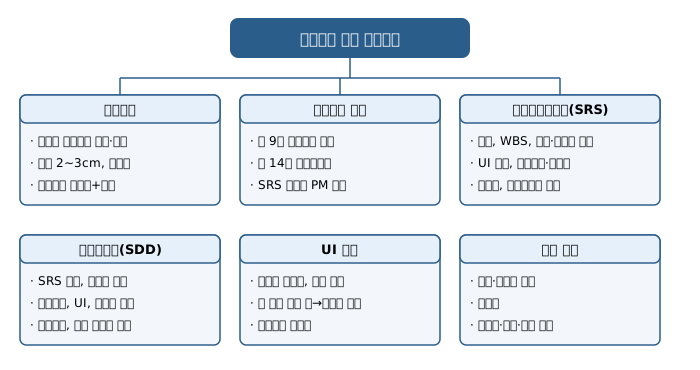
- SRS → information needed for the design phase, SDD → information needed for the implementation phase