
- Published on
CH1. Boolean Retrieval
- Authors

- Name
- seren-wib
Contents
1. Boolean Retrieval
1.1 Introduction
What information retrieval (IR) is
- Searching unstructured data (a DB table = structured)
- Finding what satisfies an information need
- Searching within a large collection (a set of documents)
Money used to go to the structured side; these days it goes to the unstructured side
Boolean retrieval model
- The simplest model for building an IR system
- The query is a Boolean expression (e.g. Caesar AND Brutus)
- Returns every document that satisfies the expression, in no order
How Google does it
- anchor text: if the link text another page uses to link to this page contains the query word, this page shows up even if the word isn't in its body
- Word variants: verb forms, spellings, and synonyms show up too
- For long queries, results show up even if a few words are missing
- When the expression returns too few results, it widens the conditions
- ranking: plain Boolean returns results in no order, but Google puts the good results on top (continued in ch6 6.1)
1.2 Inverted index
grep doesn't work → try a matrix → the matrix is too big → store only the 1s = inverted index
Why grep doesn't work
- It's slow (with a large collection it has to read everything from the start)
- grep works line by line, but IR works document by document
- Things like NOT~ need the whole document checked, so it's hard
- It can't do proximity search like "countryman near Romans"
Term-document incidence matrix
- Rows are terms, columns are documents
- 1 if the term is in the document, 0 if not
- Each row is a (0/1) vector; do bit operations on these vectors
| Anthony and Cleopatra | Julius Caesar | The Tempest | Hamlet | Othello | Macbeth | |
|---|---|---|---|---|---|---|
| Anthony | 1 | 1 | 0 | 0 | 0 | 1 |
| Brutus | 1 | 1 | 0 | 1 | 0 | 0 |
| Caesar | 1 | 1 | 0 | 1 | 1 | 1 |
| Calpurnia | 0 | 1 | 0 | 0 | 0 | 0 |
| Cleopatra | 1 | 0 | 0 | 0 | 0 | 0 |
| mercy | 1 | 0 | 1 | 1 | 1 | 1 |
| worser | 1 | 0 | 1 | 1 | 1 | 0 |
- Query:
Brutus AND Caesar AND NOT Calpurnia/ one position = one document, AND the same positions together
                A&C  JC  Tmp  Ham  Oth  Mac
Brutus           1    1   0    1    0    0
Caesar           1    1   0    1    1    1
NOT Calpurnia    1    0   1    1    1    1    (010000 -> 101111)
---------------------------------------------
AND              1    0   0    1    0    0    = 100100
- Result: Anthony and Cleopatra, Hamlet / Julius Caesar drops out because it contains Calpurnia
- As the collection grows, the matrix blows up
- token: every word occurrence, duplicates included
- term: distinct words, duplicates removed
- e.g. "the the the" has token=3, term=1
| Item | Value |
|---|---|
| Number of documents N | 10⁶ |
| Tokens per document | about 1000 → 10⁹ tokens total |
| Size per token | 6 bytes (incl. spaces and punctuation) → collection about 6GB |
| Distinct terms M | 500,000 (= number of rows) |
| Matrix cells | 500,000 × 10⁶ = 5×10¹¹ |
| Number of 1s | at most 10⁹ (one token makes at most one cell a 1) |
- There are 5×10¹¹ cells but at most 10⁹ of them are 1, so almost everything is 0. This is called a sparse matrix. All the space goes to storing 0s, so the conclusion is to write down only the 1s
- Inverted index
For each term, store only the list of document numbers (docIDs) that contain it
Brutus    -> 1 -> 2 -> 4 -> 11 -> 31 -> 45 -> 173 -> 174
Caesar    -> 1 -> 2 -> 4 -> 5 -> 6 -> 16 -> 57 -> 132
Calpurnia -> 2 -> 31 -> 54 -> 101
- The set of terms (Brutus, Caesar, Calpurnia): dictionary
- posting: a single docID (e.g. 1)
- postings list: the list of postings (-> 1 -> 2 -> 4 ->...)
- Four steps to build an inverted index
| Step | What it does | Example |
|---|---|---|
| 1. Collect documents | Gather the documents to index | Friends, Romans, countrymen. So let it be with Caesar… |
| 2. Tokenize | Split documents into tokens | Friends Romans countrymen |
| 3. Linguistic preprocessing | Normalize tokens → index terms. Lowercase, strip plurals | friend roman countryman |
| 4. Index | Build the dictionary + postings | Item 6 below |
- Example of building an inverted index
- Doc 1: I did enact Julius Caesar: I was killed i' the Capitol; Brutus killed me.
- Doc 2: So let it be with Caesar. The noble Brutus hath told you Caesar was ambitious:
| Step | What it does | Result |
|---|---|---|
| ① Preprocess | Lowercase, remove punctuation | i did enact julius caesar i was killed … |
| ② (term, docID) pairs | In order of appearance | (i,1) (did,1) (enact,1) … (caesar,2) (was,2) (ambitious,2) |
| ③ Sort | By term alphabetically, then by docID | (ambitious,2) (be,2) (brutus,1) (brutus,2) … |
| ④ Merge + df | Group the same term into a postings list | Table below |
| ⑤ Split | Store dictionary (term + df) and postings file separately |
| term | df | postings |
|---|---|---|
| brutus | 2 | 1 → 2 |
| caesar | 2 | 1 → 2 |
| i | 1 | 1 |
| was | 2 | 1 → 2 |
- df (document frequency): the number of documents a term appears in (not the number of occurrences) / caesar appears twice in Doc 2 but df = 2; i appears twice in Doc 1 but df = 1
Building large indexes is in ch4, compression in ch5, and indexes for ranked retrieval in ch6–7.
1.3 Processing Boolean queries
Steps for processing a two-term AND query
- Query: Brutus AND Calpurnia
- Look up Brutus in the dictionary
- Fetch Brutus's postings list
- Look up Calpurnia in the dictionary
- Fetch Calpurnia's postings list
- Intersect the two postings lists
- Return the result
Intersection algorithm (Intersect)
Brutus    -> 1 -> 2 -> 4 -> 11 -> 31 -> 45 -> 173 -> 174
Calpurnia -> 2 -> 31 -> 54 -> 101
Answer    => 2 -> 31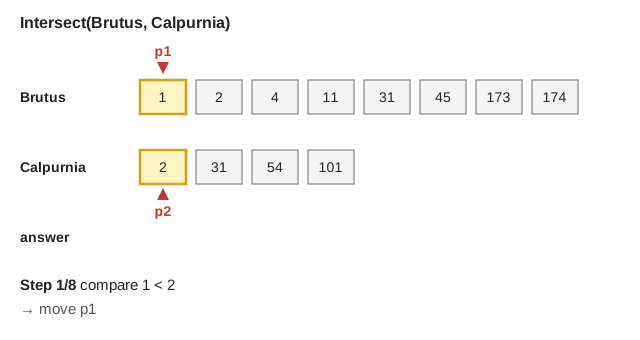
| Step | p1 (Brutus) | p2 (Calpurnia) | Compare | Action |
|---|---|---|---|---|
| 1 | 1 | 2 | 1 < 2 | advance p1 |
| 2 | 2 | 2 | equal | add 2, advance both |
| 3 | 4 | 31 | 4 < 31 | advance p1 |
| 4 | 11 | 31 | 11 < 31 | advance p1 |
| 5 | 31 | 31 | equal | add 31, advance both |
| 6 | 45 | 54 | 45 < 54 | advance p1 |
| 7 | 173 | 54 | 173 > 54 | advance p2 |
| 8 | 173 | 101 | 173 > 101 | advance p2 → Calpurnia ends, stop |
- Evaluating the Boolean model
- Any query that is a Boolean expression joined by AND, OR, NOT can be answered.
- It treats a document as a set of terms. It doesn't care how many times a term appears.
- It is precise. A document either matches the condition or it doesn't
- The mainstay of commercial search tools for 30 years
- Spotlight, email search, and intranet search are Boolean too.
- Westlaw (the largest legal search service by number of paying subscribers)
- Boolean search is still the default
| Symbol | Meaning | Example |
|---|---|---|
/3 | within 3 words | employment /3 place |
/s | in the same sentence | disclos! /s prevent |
/p | in the same paragraph | host! /p guest |
| space | OR (Google uses AND) | responsib! liab! = responsib! OR liab! |
! | anything may follow | employe! → employee, employer, employed |
"…" | phrase: adjacent, in that order | "trade secret" |
| Information need | Query | Read as |
|---|---|---|
| Host's liability for an intoxicated guest | host! /p (responsib! liab!) /p (intoxicat! drunk!) /p guest | host, (responsib OR liab), (intoxicat OR drunk), guest in the same paragraph |
| Legal theory for stopping a former employee from disclosing trade secrets | "trade secret" /s disclos! /s prevent /s employe! | "trade secret", disclos, prevent, employe in the same sentence |
| Workplace access requirements for people with disabilities | disab! /p access! /s work-site work-place (employment /3 place) | disab in the same paragraph, access in the same sentence + (work-site OR work-place OR place within 3 words of employment) |
- Why people prefer Boolean: precision, transparency, control
1.4 Query optimization
With three or more ANDs, the order matters
- Efficiency depends on which operation runs first.
So which one goes first?
- AND the postings lists starting from the shortest (smallest df).
Optimized intersection algorithm
- Sort terms by increasing df
- Start result with the shortest list; keep only the remaining terms
- Intersect result with the next list using the 1.3 Intersect
- Repeat 3 while terms remain and result isn't empty
- Return result
- If result becomes empty midway, stop right away (ANDing anything after it gives the empty set)
- e.g. in the order Caesar(2) → Calpurnia(4) → Brutus(8) / Caesar ∩ Calpurnia = 31, ∩ Brutus = 31
Intersect(<t1, ..., tn>)
 1 terms <- SortByIncreasingFrequency(<t1, ..., tn>)
 2 result <- postings(first(terms))
 3 terms <- rest(terms)
 4 while terms != nil and result != nil
 5 do result <- Intersect(result, postings(first(terms)))
 6    terms <- rest(terms)
 7 return result
Queries with OR mixed in
- Get the df of every term
- Estimate the size of each OR as the sum of its two dfs
- Process the ORs with the smallest estimated size first
- This estimate is called conservative, because the sum of the two dfs is an upper bound on the OR result.