
- Published on
CH7. Scores in a Complete Search System
- Authors

- Name
- seren-wib
Contents
7. Scores in a complete search system
7.1 Why rank?
Why does ranking matter so much → users only look at the top few results
Why ranking matters (continued from ch6 6.1)
- Users want to see a few results, not thousands
- Writing a query that returns only a few results is hard, even for experts
- Ranking = shrinking a large result set down to a very small one (you only need to look at the top few)
Confirmed by experiment (Dan Russell at Google, 2007)
- Observe people searching in a controlled setting: recording, think aloud, interviews, eye-tracking, timing, counting clicks
Results
- Reading snippets: snippets at ranks 1~4 are read far more than ranks 7~10
- Clicks: skewed even more toward the top than reading
- 1 in 2 clicks goes to rank 1, and 30% still click rank 1 even when it is not relevant
- Conclusion: getting the ranking right matters, and getting rank 1 right matters most
Exercise: why ranking is a barrier to entry for new search engines
- Good ranking needs lots of user click and query logs → incumbents with many users keep getting better → newcomers find it hard to catch up
7.2 More on cosine
Normalizing length with cosine favors short documents → correct it with pivot normalization
Why cosine instead of distance (review of ch6 6.4)
- q [rich poor], d2 "Rich poor gap grows" → the word distribution is almost the same, but the Euclidean distance is large
- So length normalization = score with cosine
Exercise: the problem with cosine normalization
- q "anti-doping rules Beijing 2008 olympics"
- d1 = short document on 2008 Olympics doping rules / d2 = d1 + 5 unrelated articles (long document) / d3 = short document on doping at the 2004 Athens Olympics
- Cosine penalizes the long d2 (its score is lower even though it contains all of d1) → it can even fall behind d3
Pivot normalization
- On average, cosine normalization gives weights that are too large for short documents and too small for long ones
- Graph: x = document length, y = probability of relevance. The real probability is higher for longer documents, but the probability cosine predicts is lower than that → the length where the two lines cross = pivot
- Correction: rotate the normalization line around the pivot (linear adjustment)
- Effect: short document scores ↓, long document scores ↑ → removes the unfair advantage of short documents
- Amit Singhal's experiments: pivot normalization raised the number of relevant documents found and the average precision
7.3 The complete search system
Putting together the parts we have learned into one search system
Tiered index
- Split the index into several tiers by importance. Example: tier 1 = title index, tier 2 = the rest of the body (a page with the query term in its title is a better result than one with it only in the body)
- Processing: start at tier 1 → stop once there are k (e.g. 100) or more results → if not enough, go to the next tier
- Slide example: tier 1 = auto → Doc2 / car → Doc1, Doc3 / insurance → Doc2, Doc3, tier 2 = best → Doc1, Doc3, tier 3 = auto → Doc1 / car → Doc2
- Considered one of the reasons early Google (2000~01) had better search quality than its competitors (along with PageRank, anchor text, and proximity constraints)
Tier design criteria (exercise)
- Each tier about 10 times smaller than the next
- For most queries the top 100 should be found in tier 1, and most of the rest in tier 2
- The "can we stop here?" check should be simple
- If you have to search almost every tier each time, splitting is pointless
Components of a search system
Learned so far Not yet covered Document preprocessing (ch2) Document cache: used to build result snippets Positional index (ch2) Zone index: index body, emphasized text, anchor text and metadata separately Tiered index (7.3) Machine-learned ranking functions Spelling correction (ch3) Proximity ranking: rank documents where query terms appear close together higher k-gram index for wildcards and spelling correction (ch3) Query parser Query processing, document scoring (ch1, ch6) Problems when mixing with vector space retrieval
- Phrase search + vector space: we can't compute df and idf for every possible phrase (there are far too many phrases)
- Boolean + vector space:
+(must include) /-(exclude) conditions → postfiltering is simple but can be very inefficient, no easy answer - Wildcard + vector space: no easy answer either
7.4 Implementation of ranking
Making scoring fast: put tf in the postings → pick only the top k → stop early without looking at everything
Storing tf in postings
- Posting = (docID, tf). Example: Brutus → (1,2) (7,3) (83,1) (87,2) / Caesar → (1,1) (5,1) (13,1) (17,1) / Calpurnia → (7,1) (8,2) (40,1) (97,3)
- Store tf as an integer (real-valued log weights are hard to compress). Adds at most 1 byte per posting
- Positions are needed too, but left out here
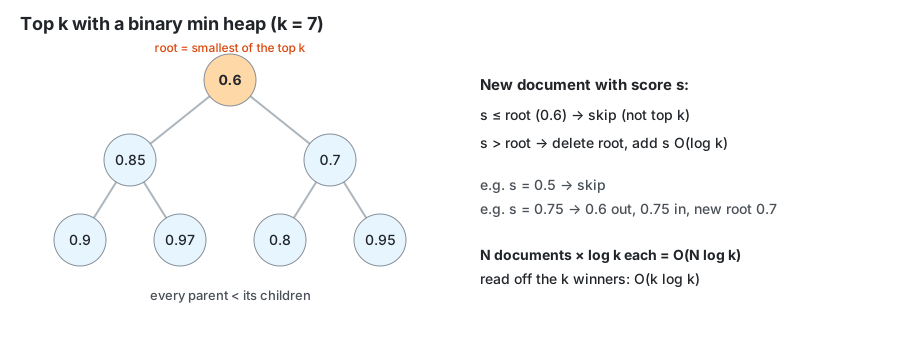
Selecting the top k: min heap
- We don't need the full ranking, only the top k (e.g. 100)
- Naive way: score all N → sort → take the first k → inefficient
- Min heap: a binary tree with parent < children → root = minimum of the top k
- Keep the top k so far in a heap of size k. New document score s: s ≤ root → discard / s > root → remove the root and insert s (O(log k))
- Checking the root O(1), building it all O(N log k), extracting the k results at the end O(k log k)
- In the figure: k = 7, root 0.6. s = 0.5 is discarded; s = 0.75 pushes out 0.6 and goes in → new root 0.7
Faster? (heuristics)
- Ranking itself is O(N), with N > 10¹⁰. Optimization only shrinks the constant; it is still O(N)
- What we are doing = the kNN (k-nearest neighbor) problem for the query vector. There is no general method that is both exact and faster than N (sublinear)
- Idea 1: sort postings by "expected relevance" instead of docID (items 4 and 6)
- Idea 2: prune the search space → occasionally wrong but rarely, almost constant time in practice. This needs the document-at-a-time / term-at-a-time concepts (item 5)
PageRank-ordered postings + early termination calculation
- PageRank g(d): a query-independent "goodness" score of a page. The more good pages link to d, the larger it is (ch21)
- Sort postings by g(d), largest first: g(d1) > g(d2) > g(d3) > …
- net-score(q, d) = g(d) + cos(q, d)
- Early termination: find the top k without reading the postings to the end
- Conditions: g ∈ [0, 1], current document g(d) < 0.1, minimum of the top k so far = 1.2
- The remaining documents have g < 0.1 (because they are sorted), and cos ≤ 1 → net-score < 0.1 + 1 = 1.1 < 1.2 → none of them can enter the top k → stop
Document-at-a-time vs term-at-a-time
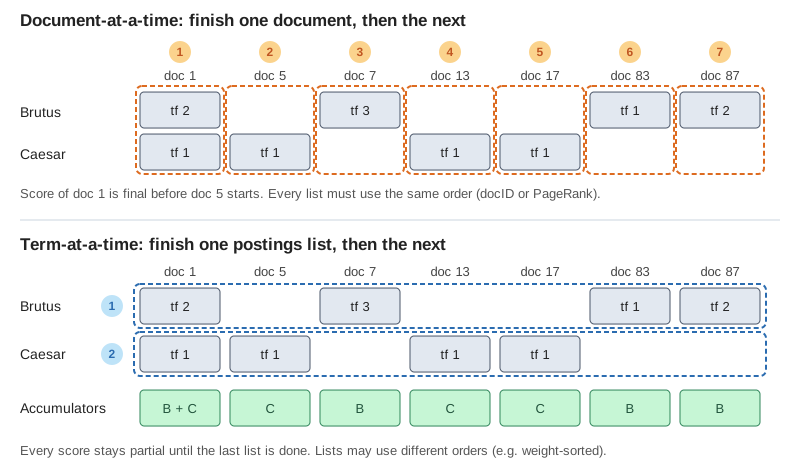
- Document-at-a-time: finish computing the score of document di before starting d(i+1)
- Both docID order and PageRank order give the same order to every postings list → this method works
- Term-at-a-time: process the entire postings list of the first query term → then the entire list of the second term → …
- Create one accumulator (running score slot) for each docID seen for the first time and keep adding to it
- In the figure: top = orange columns (documents) in order 1 → 7, a document's score is final when its column is done / bottom = blue rows (terms) in order 1 → 2, the green accumulators are final only after the last row (B + C = both Brutus and Caesar added)
Document-at-a-time Term-at-a-time Order Compute one document's score fully → next document Process all postings of the first term → all postings of the second … Condition All postings in the same order (docID or PageRank) Postings order may differ per term Intermediate state Only one document's score An accumulator per document ( Scores[]in CosineScore)- The term-at-a-time code = ch6 6.4 CosineScore as is. Each slot of
Scores[]is an accumulator
CosineScore(q) 1 float Scores[N] = 0 2 float Length[N] 3 for each query term t 4 do calculate w(t,q) and fetch postings list for t 5 for each pair(d, tf(t,d)) in postings list 6 do Scores[d] += w(t,d) * w(t,q) 7 Read the array Length 8 for each d 9 do Scores[d] = Scores[d] / Length[d] 10 return Top k components of Scores[]- Document-at-a-time: finish computing the score of document di before starting d(i+1)
Weight-sorted postings
- Idea: don't process postings that contribute little to the final score
- Sort postings by weight, largest first. In the simplest case, normalized tf-idf (rare in practice: real-valued weights are hard to compress)
- The top k documents gather near the front → stopping without reading the tail (early termination) barely changes the top k
- Cost: a document's weight differs per term, so each postings list has a different order → document-at-a-time is impossible → term-at-a-time
Accumulator calculation
- On the web (20 billion documents) the full
Scores[N]array won't fit in memory → create accumulators only for documents that appear in the postings - = no accumulator for documents with score 0 (documents with none of the query terms)
- Example: the postings in item 1 above, query [Brutus Caesar]
Processing order New accumulators created Already exists, just add Brutus postings 1, 7, 83, 87 Caesar postings 5, 13, 17 1 - Union = 1, 5, 7, 13, 17, 83, 87 (7 of them). Nothing for 3, 8, etc. (8 is only in Calpurnia)
- On the web (20 billion documents) the full
Enforcing conjunctive search
- Conjunctive (AND): look only at documents containing every query term and create accumulators only for them (Google's approach)
- In the example above: only d1 has both Brutus and Caesar → intersection = only accumulator 1
Summary
- Scoring every document in the collection makes ranking very expensive
- But most documents score 0 for a query → lots of room to speed things up
- Still, there is no fast nearest-neighbor algorithm that is always exact → in practice, heuristics narrow the search space, and they mostly work well